When the Heart Makes You Listen ❤️

Medical Warnings
When the Heart Makes You Listen ❤️
Sometimes an image pulls you into a writing prompt before you have even finished reading the words.
For me today, it was the heart.
Here in the Canary Islands, we have a healthcare system that I am very grateful for. My husband and I receive disability pensions from Norway, and through the arrangements that come with that, we receive healthcare here much as local residents do.
This year, that healthcare system discovered something about my heart that I didn’t know was there.
In January, I was having several tests before a scheduled operation.
Only a few weeks earlier, I had made a trip to the emergency room because I was experiencing pressure in my chest and having trouble breathing. They performed an ECG, but it appeared normal.
So I went home.
Then came the tests for my operation.
And this time, they found something.
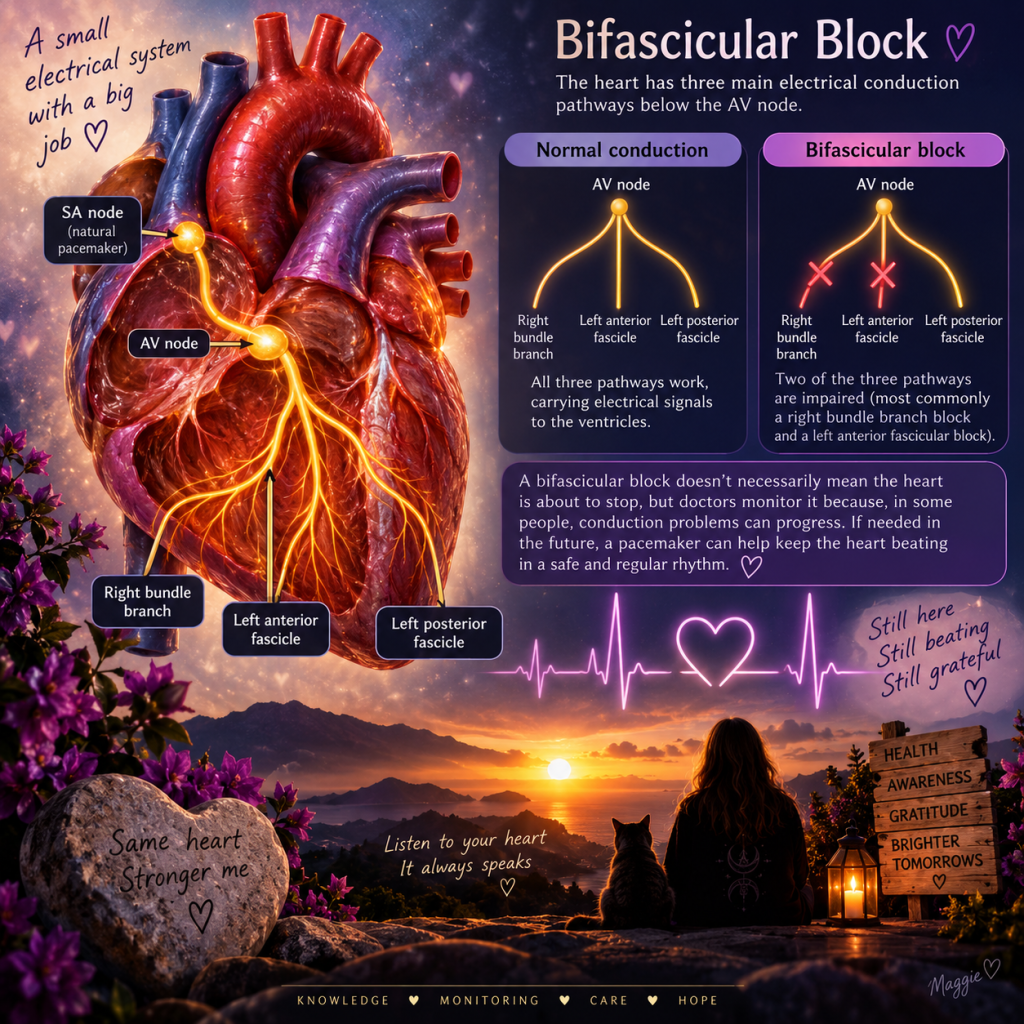
I was diagnosed with a bifascicular block.
The heart isn’t only the symbol we use for love, emotion and everything sentimental. It also has its own remarkable electrical system, sending signals that tell it when and how to beat.
In simple terms, there are three main electrical conduction pathways below the AV node. With a bifascicular block, two of those pathways are impaired.
That doesn’t mean my heart is about to stop. But it is something my doctors take seriously and monitor because, in some people, conduction disease can progress.
Suddenly, my upcoming operation felt very different.
Because I needed anaesthesia, my cardiologist was present during the operation.
I was frightened.
Very frightened.
There is something about hearing that doctors have found a problem with your heart that makes everything else disappear for a moment.
We spend most of our lives hardly thinking about what that extraordinary organ is doing.
Beat.
Beat.
Beat.
Quietly in the background while we raise our children, fall in love, laugh, cry, argue, make memories, write stories, drink coffee and simply get on with another ordinary day.
Until one day, someone tells you that the electrical signals aren’t travelling through your heart quite as they should.
My doctors have explained that if the conduction problem worsens, I may eventually need a pacemaker.
Of course, that’s frightening to hear.
But underneath the fear, I feel something else too.
Gratitude.
I’m grateful they found it.
I’m grateful it was discovered while doctors were already examining me carefully.
And most of all, I’m grateful that now I know.
Knowing means I can attend my check-ups.
Knowing means my doctors can monitor it.
Knowing means I can take symptoms seriously and look after my heart instead of assuming everything must be fine because one ECG looked normal.
Perhaps that’s what Jim’s image made me think about most today.
We talk so often about listening to our hearts in the poetic sense.
Follow your heart.
Trust your heart.
Speak from your heart.
As a writer, I probably use the heart symbolically more often than I can count.
But sometimes we need to listen to the physical heart, too.
That little electrical system working quietly inside us deserves our attention.
Mine gave me a warning.
Thankfully, someone was listening.❤️
With love, coffee, poetry, and stardust,
— Maggie The Afterlove Voice 💫

My new single is out
https://ditto.fm/silenced-but-not-broken
Lyrics video

If you want a reading, send me an email:











Leave a comment