
His Worst Hours Are Not His Biography
When reporting becomes exploitation — and apparently Argentine pesos become US dollars
August is Liam Payne’s birthday month.
Across social media, fans are doing something beautiful.
Every day, we are sharing his music, his performances, his laughter, his charity work, childhood photographs, favourite interviews and memories.
We are streaming his songs.
We are remembering the artist.
The father.
The son.
The brother.
The friend.
The human being.
On August 29, Liam would have turned 33.
And once again, while fans are trying to honour his life, parts of the media appear determined to drag everyone back into the final hours of his death.
I have seen this before.
Around Liam’s birthday last year, the headlines came.
Around the first anniversary of his death, they came again.
And now, during another month dedicated by fans to celebrating Liam, we are being presented with supposedly shocking photographs, intimate allegations and lurid descriptions of his final days.
I believe completely in freedom of the press.
But freedom of the press should never become a licence to trample over the dignity of another human being.
Freedom of expression does not eliminate responsibility.
The right to report does not eliminate ethics.
And public interest is not the same thing as the public being interested.
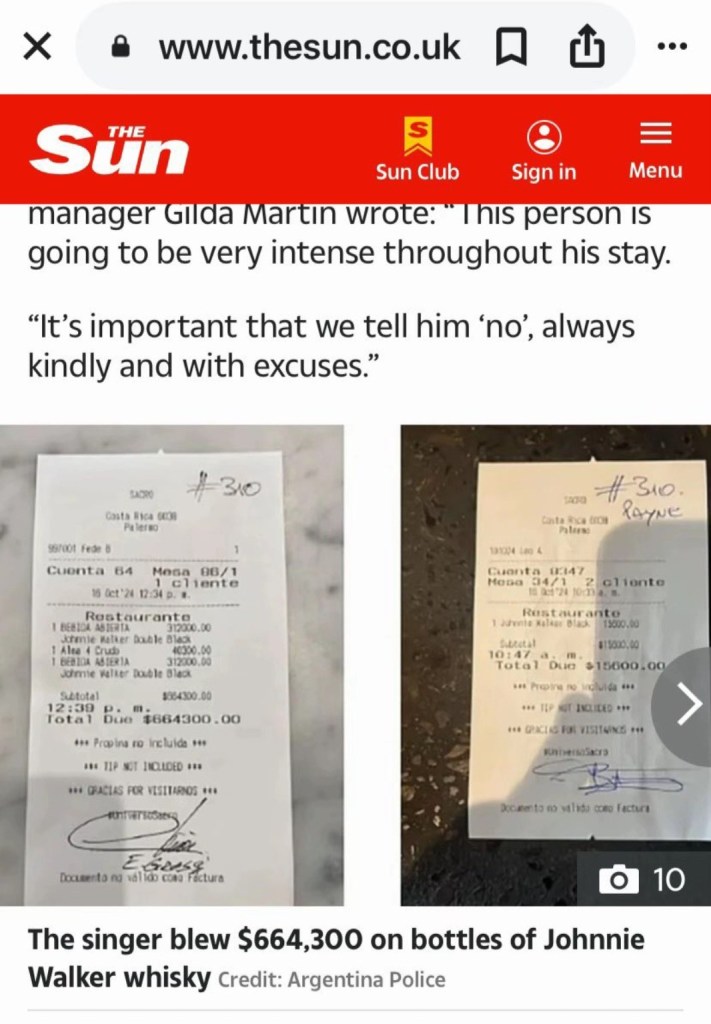
Apparently Nobody Has Heard of Argentine Pesos
One particular headline stopped me in my tracks.
A photograph of a restaurant receipt from Argentina was accompanied by the claim:
“The singer blew $664,300 on bottles of Johnnie Walker whisky.”
Excuse me?
$664,300?
Perhaps somebody should introduce the British tabloids to a little-known currency called the Argentine peso.
The receipt photographed in the article shows a total of $664,300.00.
But in Argentina, the $ symbol is also used for Argentine pesos. A $ on an Argentine receipt does not automatically mean US dollars.
That distinction isn’t some insignificant detail when publishing a story for an international audience.
There is an enormous difference between telling readers someone spent 664,300 Argentine pesos and allowing them to believe someone spent US$664,300.
If you’re going to publish evidence from an Argentine investigation, surely understanding the currency printed on an Argentine receipt would be a reasonable place to start.
And if something as elementary as that can be presented so misleadingly, readers have every right to scrutinise the rest of the reporting carefully.
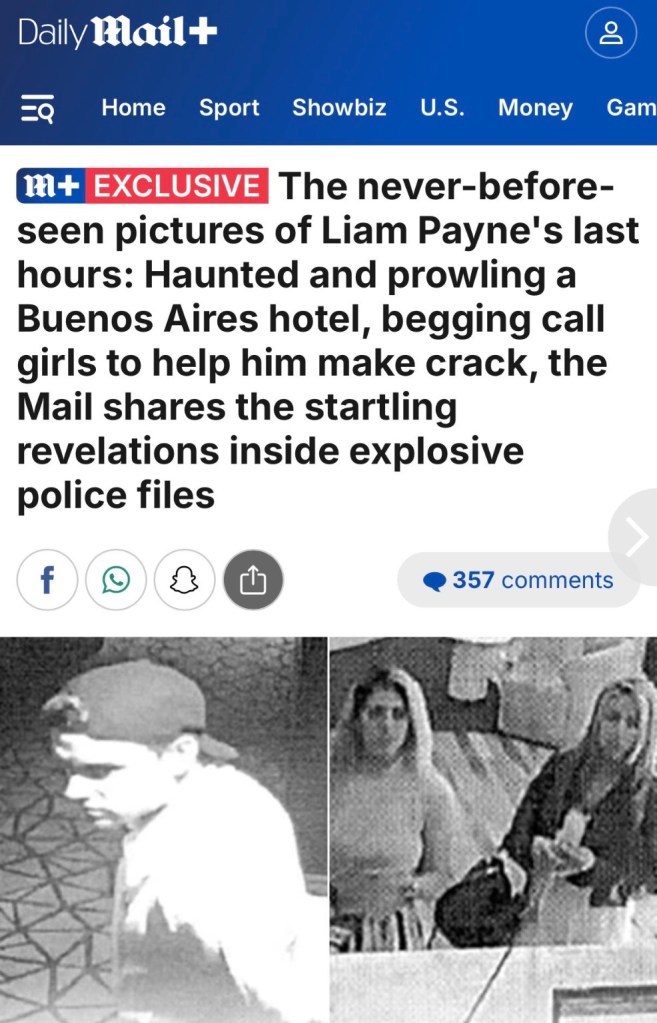
The “Never-Before-Seen” Photograph
Then came another headline:
“The never-before-seen pictures of Liam Payne’s last hours…”
One of those images supposedly shows Liam inside the CasaSur hotel.
And immediately I had a question.
Where is his beard?
I’m not claiming that a grainy CCTV screenshot proves the person isn’t Liam. It doesn’t.
But when journalists present photographs as evidence from a man’s final hours, basic questions about identification, timestamps and chronology matter.
If photographs supposedly taken within a relatively short period appear to show significant differences in Liam’s appearance, journalists should explain the provenance and timing of those photographs.
When was it taken?
What is its original timestamp?
Which camera recorded it?
How was the person identified?
Has that identification been independently verified?
Where does it fit within the established timeline?
Those aren’t conspiracy questions.
Those are evidence questions.
Listen to what Vic is saying here about Liam’s case
Liam Deserves Better Than This
What bothers me most isn’t merely one bad caption or one questionable photograph.
It’s the relentless reduction of Liam Payne to the worst and most vulnerable hours of his life.
Liam lived for 31 years.
Yet again and again, we are invited to stare at a tiny window at the very end and pretend that it explains the entire man.
It doesn’t.
His struggles were part of his story.
They were not his entire story.
Whatever happened during his final hours does not erase the father who adored his son.
It doesn’t erase his family.
It doesn’t erase One Direction.
It doesn’t erase the songs.
It doesn’t erase the laughter.
It doesn’t erase the charitable work he often did quietly.
It doesn’t erase the people he helped.
And it doesn’t erase the millions of people whose lives his music touched.
His worst hours are not his biography.
Think About His Family
Sometimes I wonder whether the people writing these headlines stop for even a moment and remember that the person they’re dissecting had a family.
Liam’s parents lost their son.
His sisters lost their brother.
His friends lost someone they loved.
And his son lost his father.
They don’t get to experience Liam’s birthday simply as a beautiful memory.
They don’t get to approach the anniversary of his death like another date on a newsroom calendar.
These dates belong to their grief.
Imagine opening your phone during the birthday month of somebody you loved and discovering that intimate details from their darkest hours have once again been turned into entertainment for strangers.
Imagine knowing that photographs and allegations concerning someone you loved are being packaged behind paywalls because publishers know curiosity will generate clicks.
Where does journalism end and exploitation begin?
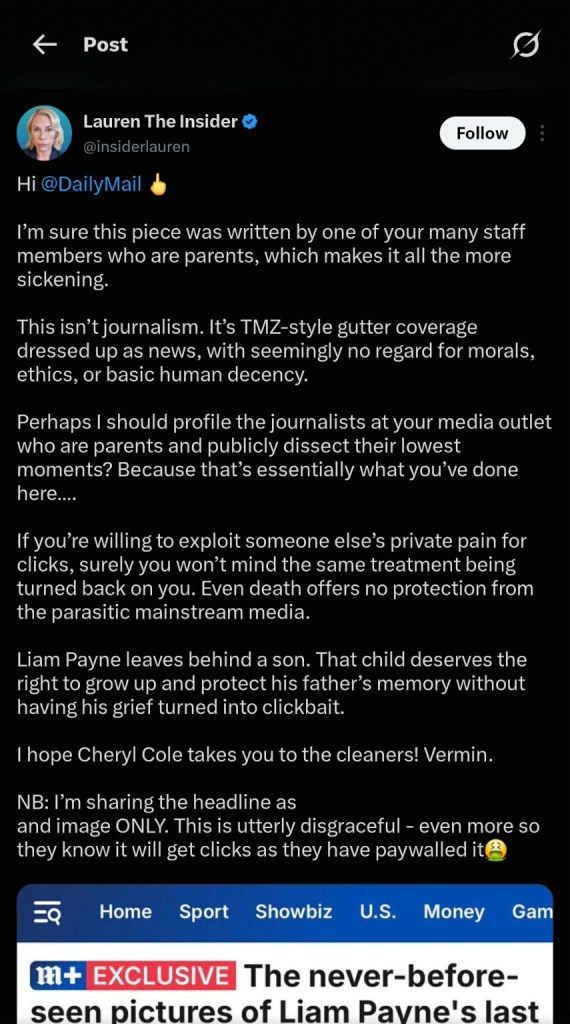
Finally, Someone Said It
That’s why I was glad to see journalist Lauren The Insider publicly condemn the latest coverage.
Whatever anyone thinks about individual allegations surrounding Liam’s death, there needs to be room for another conversation:
Media ethics.
Investigate Liam’s death.
Ask difficult questions.
Examine the evidence.
Challenge inconsistencies.
Report developments in the criminal proceedings.
Absolutely.
But humiliating a dead man is not a prerequisite for doing any of those things.
If newly obtained police material genuinely changes our understanding of what happened on October 16, 2024, then tell us what it proves.
Authenticate it.
Timestamp it.
Contextualise it.
Compare it with the existing evidence.
That’s journalism.
Don’t simply find the most degrading detail available and build the biggest headline possible around it.
This August, We Choose Liam
Meanwhile, Liam’s fans are doing something entirely different.
Day by day throughout August, social media is filling with Liam.
Liam smiling.
Liam dancing.
Liam singing.
Liam with his family.
Liam performing at Soccer Aid.
Liam being ridiculous.
Liam being kind.
Liam making music.
Liam being Liam.
And on August 29, thousands upon thousands of people around the world will wish him a happy birthday.
Perhaps that is why I feel so strongly about this.
We aren’t pretending Liam was perfect.
Nobody needs him to have been.
We are simply refusing to allow the final hours of October 16, 2024, to consume the other 31 years of his existence.
There is a human being behind those headlines.
There is a grieving family behind those clicks.
There is a little boy who will one day be old enough to search his father’s name.
And there are millions of people who remember something the tabloids seem determined to forget:
Liam Payne was more than the circumstances of his death.
Much, much more.
So this August, they can publish their headlines.
We will publish his music.
They can recycle his darkest hours.
We will remember his brightest ones.
They can chase clicks.
We will say his name with love.
Happy birthday month, Liam. 💜🕊️
29 August 1993 — 16 October 2024
Forever 31.
#LiamPayne #HappyBirthdayLiam #HonouringLiam #RememberingLiam #JusticeForLiam #MediaEthics #HisWorstHoursAreNotHisBiography #TheAfterloveVoice
With love, coffee, poetry, and stardust,
— Maggie The Afterlove Voice 💫

https://ditto.fm/silenced-but-not-broken
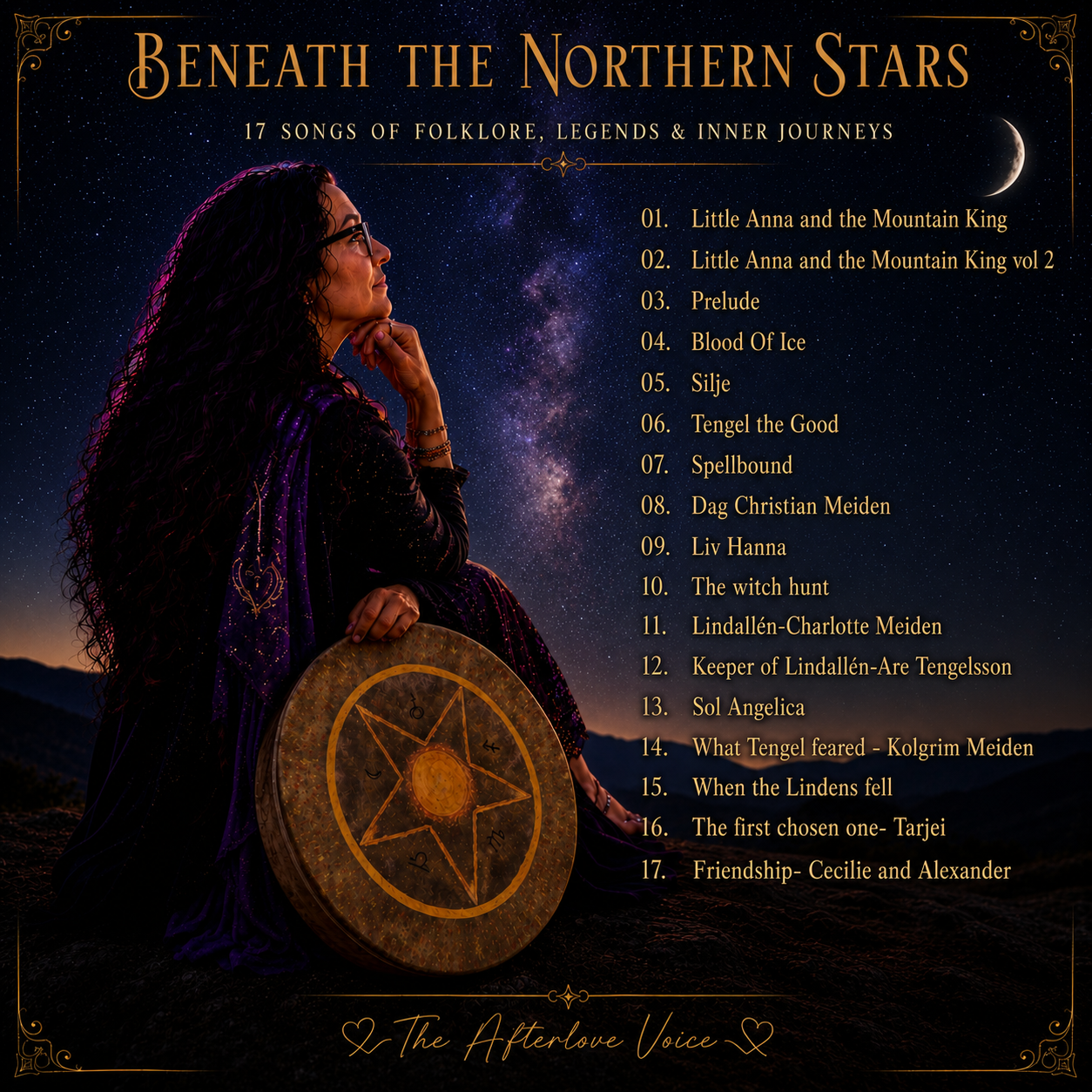
🌙 Beneath the Northern Stars – My New Album
If you want a reading, send me an email:









Leave a comment